


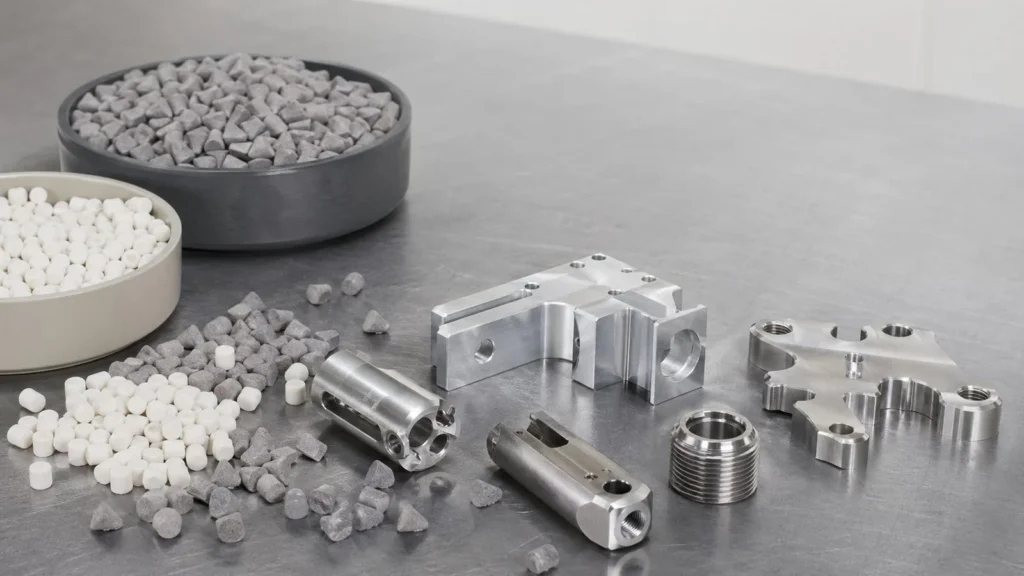
How to Prevent Tumbling Media from Lodging in Holes, Slots, and Threads
Media lodging is one of the most common problems in mass finishing. When ceramic, plastic, or steel media gets stuck inside holes, slots, grooves, threads, or blind cavities, it slows production, increases manual cleaning work, and may even damage finished parts.
The good news is that most lodging problems can be reduced before production starts. The key is to match the part geometry with the right machine motion, media shape, media size, compound, separation method, and process time. This guide explains how to diagnose the cause and build a more reliable finishing process.

Why Media Gets Stuck in Parts
Media lodging usually happens when the media can enter a feature but cannot escape easily during the finishing cycle. This is common on CNC parts, die castings, machined aluminum parts, stainless steel components, zinc alloy parts, and small precision hardware.
Geometry mismatch
If the media size is too close to the hole, slot, groove, or thread pitch, it can wedge into the part during vibration or tumbling.
Wrong media shape
Triangles, cones, cylinders, balls, and angle-cut media behave differently. A shape that works well on open surfaces may lodge inside blind holes.
Excessive cutting action
Stronger cutting media can push into edges and recesses more aggressively, especially when the part has sharp transitions or deep pockets.
Poor separation
Even if media does not lodge during processing, it may remain inside cavities if the unloading, rinsing, or screening step is not designed well.
Start with Part Geometry, Not the Machine
Before choosing a vibratory finishing machine or any other mass finishing equipment, inspect the part features that may trap media. The most important dimensions are hole diameter, slot width, groove depth, thread size, blind cavity depth, and the direction of openings.
A simple rule is to avoid media that can enter a feature and rotate into a locked position. For example, a media piece that is slightly smaller than a hole may enter easily but become difficult to remove after vibration, especially if the hole is deep or threaded.
Media Selection Guide for Lodging Prevention
| Part Feature | Common Risk | Better Media Choice | Process Note |
|---|---|---|---|
| Small through holes | Media enters and blocks the hole | Use media larger than the hole, or much smaller if it can pass through freely | Avoid media size close to the hole diameter |
| Blind holes | Media enters but cannot exit | Consider rounded or non-wedging shapes | Rinsing and air blow-off may be required after finishing |
| Narrow slots | Angle-cut media wedges into the slot | Use rounder shapes or adjust media size | Check slot width and depth before production |
| Threads | Media locks into thread pitch | Use smaller smooth media or avoid aggressive angular shapes | Protect critical threads when tight tolerance is required |
| Complex die castings | Media remains in ribs, pockets, or cavities | Test plastic media or selected ceramic shapes | Design separation into the process, not as an afterthought |
Ceramic Media or Plastic Media?
Ceramic media is often used for stronger deburring, edge breaking, and surface smoothing. It is durable and effective, but some shapes may lodge in holes or slots if the size is not selected carefully.
Plastic media is usually lighter and more suitable for softer metals, aluminum parts, zinc alloy die castings, and parts where surface impact must be reduced. For parts with delicate edges or decorative surfaces, plastic media can reduce part-on-part damage and help create a more controlled finish.
The best choice depends on the material, burr size, target surface, and part geometry. For parts with many holes and recesses, media shape and size are often more important than simply choosing ceramic or plastic.
Machine Motion Also Matters
Different machines move parts and media in different ways. A standard vibratory bowl is efficient for many batches, while tub vibrators are often used for longer or larger components. Barrel finishing machines can be useful for gentler rolling action, while centrifugal systems may shorten cycle time for suitable parts.
If lodging happens repeatedly, do not only change media. Review the complete process: machine loading ratio, water level, compound concentration, part-to-media ratio, cycle time, and separation method.
Use Compound and Water Flow Correctly
Finishing compounds help clean the surface, control foam, suspend removed particles, and improve media movement. Poor lubrication can increase friction and make media more likely to wedge into part features.
In wet finishing, water and compound should support smooth rolling action. Too little liquid may make the mass too dry and aggressive. Too much liquid may reduce finishing efficiency and affect media movement. The correct range depends on the machine, media, and part load, so sample testing is recommended before production.
Common Mistakes to Avoid
- Choosing media only by cutting strength without checking hole and slot dimensions.
- Using one media shape for every part in the factory.
- Running longer cycle times to solve a problem that is actually caused by wrong media size.
- Ignoring unloading and separation until after the process is already fixed.
- Using aggressive media on delicate threaded or precision-machined parts without testing.
- Forgetting to check whether media can be removed by rinsing, screening, air blow-off, or manual inspection.
Recommended Testing Process
For parts with holes, slots, threads, or internal cavities, the safest approach is to test several media options before confirming mass production. A practical test should compare finishing result, burr removal, surface roughness, lodging rate, separation efficiency, and total cycle time.
Related Solutions
If you are building or improving a mass finishing process, these pages may help you compare suitable equipment and consumables:
Need Help Choosing Media for Complex Parts?
If your parts have holes, slots, grooves, threads, or blind cavities, send us the part material, dimensions, current surface condition, burr condition, and target finish. Our finishing team can help recommend a suitable machine, media shape, compound, and sample testing process.
 +86-592-2381506

 IPv6 network supported