


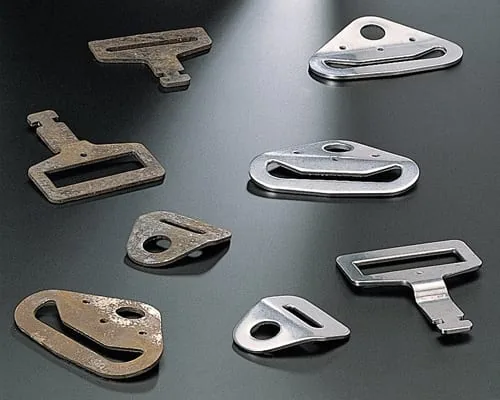
Stamping, blanking, punching, and fine blanking can leave a raised burr on the die side of a component. The burr may interfere with assembly, damage a coating, create a handling hazard, or prevent a part from seating correctly. Mass finishing can remove light and moderate burrs from large batches, but simply placing thin parts into an aggressive machine can replace one defect with several new ones.
Flat parts may stack and shield each other. Open clips can hook together. Long narrow stampings can bend. Cosmetic faces can rub against one another, while small holes may trap worn media. A reliable process therefore depends on the whole system: incoming burr condition, part geometry, machine motion, media shape, load ratio, compound flow, separation, and inspection.
Start with the Burr, Not the Machine
The size and direction of the burr determine whether mass finishing is appropriate. A thin, exposed burr usually responds more predictably than a heavy rolled edge or a burr hidden inside a narrow feature. Before testing, record where the burr is located, how it varies across the batch, and which edges must remain sharp or dimensionally controlled.
| Incoming Condition | Mass-Finishing Potential | Main Validation Point |
|---|---|---|
| Light exposed stamping burr | Usually a strong candidate | Required edge break and cycle time |
| Thin flat washer or shim | Possible with controlled loading | Stacking, bending, and hole blockage |
| Open clip or spring-shaped part | Requires a tangling trial | Hooking, opening force, and distortion |
| Heavy rollover or torn edge | May need a prior cutting step | Whether the defect is removable without over-rounding |
| Critical sealing or locating edge | Use conservative conditions | Dimensional capability after finishing |
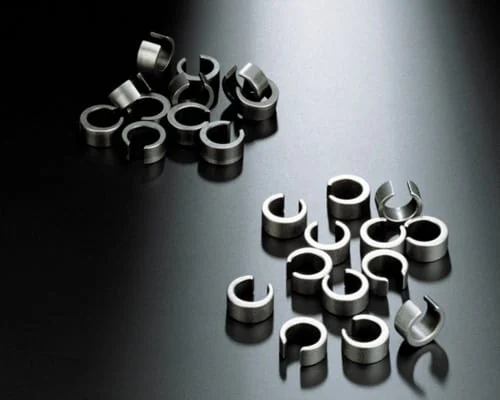
Why Stamped Parts Tangle, Stack, or Distort
Part interaction is often the limiting factor. A process may remove the burr successfully while producing an unacceptable number of bent or marked parts. The following risks should be tested separately rather than grouped under a general finish inspection.
- Tangling: hooks, open loops, spring legs, and long slots can interlock as the load circulates.
- Stacking: flat washers, shims, and discs can nest together, preventing media and compound from reaching the covered faces.
- Distortion: thin sections can flex under the weight of the load or from aggressive machine motion.
- Impingement: exposed cosmetic surfaces can strike each other when the media-to-parts ratio is too low.
- Media lodging: worn media can enter holes, slots, and folded features and become difficult to separate.
A small controlled batch should include the most fragile geometry and the widest expected range of incoming burrs. If the sample contains only the strongest or easiest parts, the result will not represent production.
Choose the Machine Around Part Motion
Machine choice affects how the parts circulate, how much energy reaches the edges, and how easily the batch can be separated. A vibratory finishing machine is a practical starting point for many stampings because its action is controllable and compatible with wet compounds and automated separation.
| Equipment | Best Starting Application | Watch For |
|---|---|---|
| Vibratory bowl | High-volume small and medium stampings with stable circulation | Flat-part stacking and screen separation |
| Vibratory tub | Long brackets, delicate parts, and divided batches | Correct chamber length and unloading method |
| Rotary barrel | Gentle economical finishing when cycle time is less critical | Part-on-part contact and manual separation |
| Compartmented barrel | Parts that must remain isolated during finishing | Lower throughput and more loading labor |
For a broader comparison of machine motion, review vibratory finishing versus barrel tumbling. Long stampings and parts that need dividers should also be evaluated in tub vibrators rather than assuming that a round bowl is the only option.
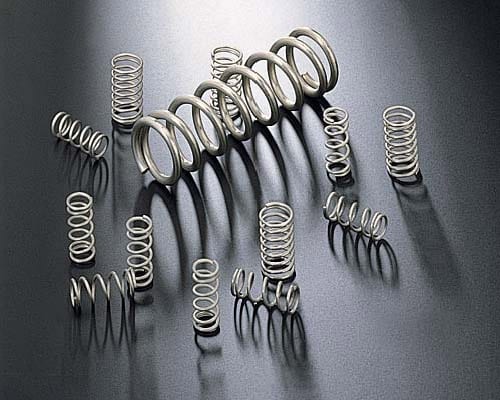
Select Media by Edge Access and Contact Risk
Media must reach the burr without entering features where it can lodge. It must also create enough space between parts to reduce direct impact. Shape is therefore as important as abrasive strength.
Ceramic media can provide stronger cutting action for harder alloys and more persistent burrs. Plastic media is often a useful starting point for thin, soft, or cosmetic parts because it generally offers a gentler cut and lower bulk density. The correct choice still depends on alloy, thickness, burr height, desired edge radius, and cycle time.
Avoid a media dimension that can enter a hole or slot and rotate into a locked position. Worn media should be screened because its dimensions change during use. The practical method is to compare the smallest worn-media dimension against every opening in the part, not only the nominal dimensions printed on a media specification sheet. See the detailed guide to parts and media separation.
Control the Load Before Increasing Aggressiveness
When burr removal is slow, increasing amplitude or switching to a harder media may appear to be the fastest solution. For thin stampings, that change can increase impact marks and deformation. First confirm that the load is circulating freely and that parts are not forming bundles or stacks.
- Begin with a conservative parts load and enough media to keep components separated.
- Observe circulation at the start, middle, and end of the trial.
- Inspect a timed sample before the estimated full cycle is complete.
- Record burr reduction, edge radius, flatness, cosmetic marks, and tangled-part count separately.
- Change only one variable at a time and keep an approved reference sample.
A suitable finishing compound helps keep removed metal and abrasive fines suspended, improves wetting, and supports consistent rinsing. Compound concentration should be controlled rather than estimated by appearance or foam level.
Build a Production Trial That Measures More Than Appearance
A visually smooth sample is not enough to approve a stamped-part process. The trial should protect the downstream function that matters to the buyer.
- Burr acceptance: maximum remaining burr or required edge radius.
- Geometry: flatness, opening width, spring force, and critical dimensions.
- Surface: scratches, impact marks, discoloration, and coating readiness.
- Handling: tangled parts, nested parts, media carryover, and separation labor.
- Consistency: results across at least several loads, including normal incoming variation.
If the process develops scratches, residue, uneven cutting, or poor circulation, use a structured vibratory finishing troubleshooting workflow instead of changing multiple settings at once.
When Another Deburring Method Is Safer
Mass finishing is not the correct answer for every stamped component. Consider brushing, precision grinding, thermal or electrochemical methods, or a dedicated trimming operation when the burr is extremely heavy, the edge is inaccessible, the part cannot tolerate bulk contact, or a critical feature requires selective material removal. A combined route may also work: remove the heavy defect first, then use mass finishing for edge smoothing, cleaning, and surface consistency.
Frequently Asked Questions
Can thin stamped washers be vibratory deburred?
Often yes, but stacking and bending must be tested. A protective media load, controlled machine intensity, and a screen that separates both parts and worn media are important.
How can spring clips be kept from tangling?
Reduce the parts concentration, use media that limits direct hooking, test a divided chamber or compartmented process, and measure the number of tangled parts per batch. Some geometries may require individual compartments.
Should ceramic or plastic media be used for stamped parts?
Ceramic media may suit harder alloys and stronger burrs. Plastic media is often gentler for thin or cosmetic parts. Final selection requires a trial using the actual alloy, burr, geometry, and finish requirement.
What information is needed for a process recommendation?
Provide the alloy, part dimensions and thickness, burr location, holes and slots, acceptable edge radius, critical tolerances, batch quantity, desired cycle time, and clear photos of the incoming and target condition.
Test the Part Before Selecting the Production System
Send representative stamped parts and your acceptance criteria. Jintaijin can evaluate machine motion, media access, tangling risk, separation, and process time before recommending a finishing configuration.
Request a Stamped-Part Finishing TrialFrequently asked questions
Why do stamped parts tangle during tumbling?
Stamped parts are thin, flat and often have hooks, tabs or holes, which lets them interlock as the media moves them. Once tangled, the parts shield each other and the burrs in the contact areas are never reached. Media shape and loading pattern are the usual places to change.
How do you stop parts from hitting each other?
Part-on-part damage is a loading problem more often than a media problem. Reducing the batch size and choosing media that keeps parts separated is more effective than slowing the process down.
What causes distortion in thin stamped parts?
Thin parts deform under mechanical load rather than cutting action. Heavy media, high loads and long cycles all increase the load. Lighter media and a shorter cycle reduce the risk.
How should media size be chosen for stamped parts?
Media is chosen from the smallest feature that has to be reached — a hole, slot or narrow recess — and then from the surface the part is allowed to lose. Size comes from the feature; grade comes from the finish.
What is the usual process route for stamped parts?
Stamped parts commonly go through a deburring stage followed by a smoothing or finishing stage. Trying to reach the final surface in one operation usually means either the burr remains or the edges round too far.
Answers are directions to test on a sample part, not validated results for a specific component.
 +86-592-2381506

 IPv6 network supported