


Walnut Shell vs Corncob: How to Choose Dry Tumbling Media for Eyewear, Jewelry & Hardware
Dry finishing media selection guide • Walnut shell & corncob • For dry tumbling, vibratory and centrifugal lines
Dry organic media — crushed walnut shell and ground corncob — is the workhorse of dry tumbling and dry vibratory finishing. The two materials look similar in the bag, but they behave very differently in the bowl. Choosing the wrong one usually shows up as dull surfaces, stuck-on compound, or parts that are clean but not bright. This guide explains what each media does, how they compare, and how to pick the right grade for eyewear, jewelry, and precision hardware.
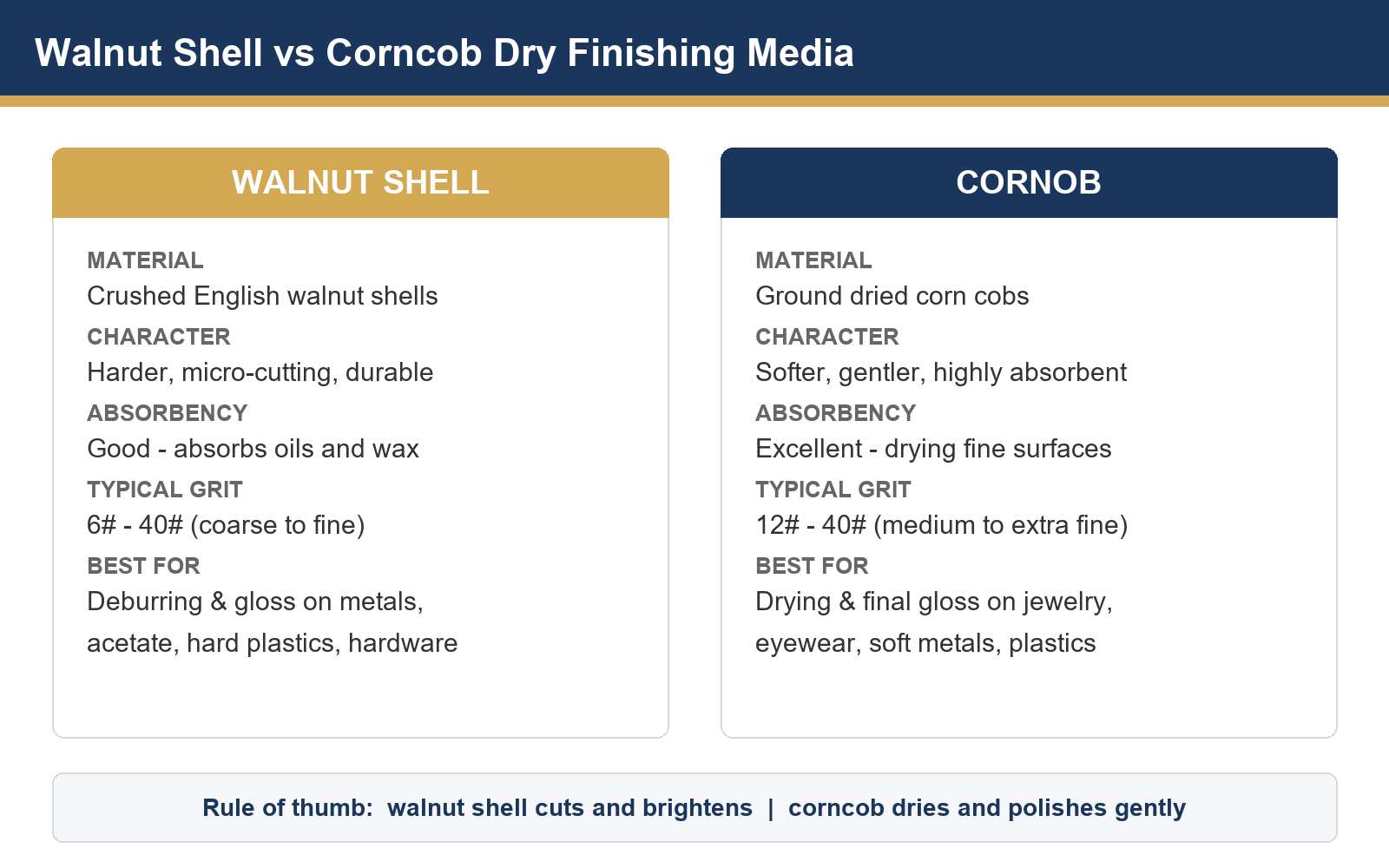
Rule of thumb. Walnut shell cuts and brightens — use it when you need to remove marks, light oxides, or burrs while building gloss. Corncob dries and polishes gently — use it to absorb oils and polishing compound while producing a soft, streak-free luster on delicate parts.
1. What Dry Media Actually Does
In a dry process there is no water or chemical solution doing the work. The media itself performs three jobs at once: it abrades (removing burrs, tool marks, and light tarnish), it carries compound (holding polishing wax against the workpiece), and it absorbs (soaking up oils, fingerprints, and spent compound so parts come out clean and dry). How aggressively a media abrades — and how well it absorbs — is exactly where walnut shell and corncob differ.
2. Walnut Shell Media: Character and Best Uses
Walnut shell is crushed hard shell, typically from English walnuts. It is noticeably harder and sharper at the particle level than corncob, which makes it a light-cutting media rather than a pure polishing media.
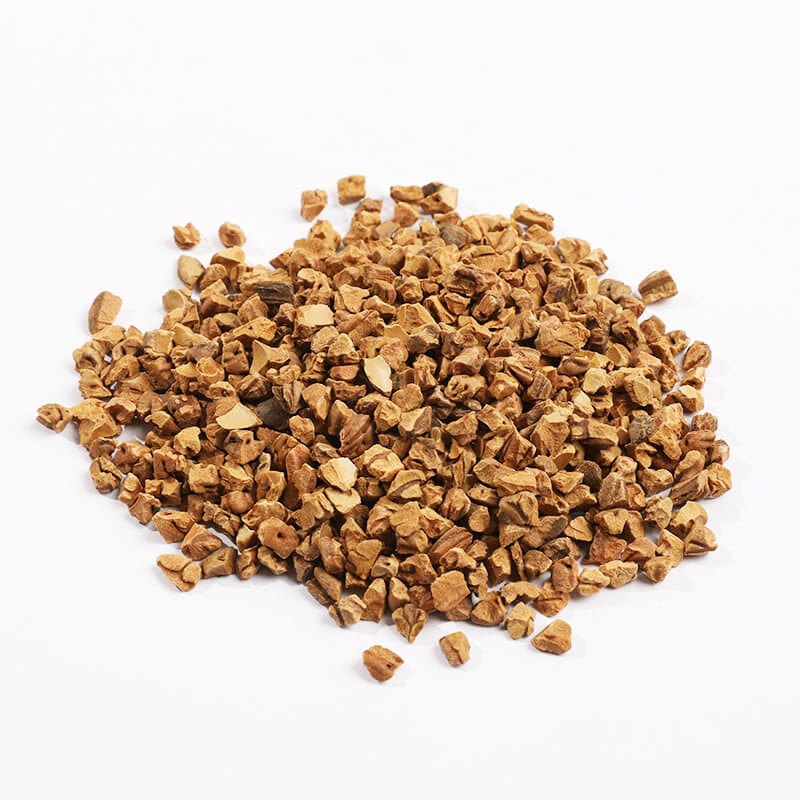
- Light cutting action: removes light burrs, parting lines, tarnish, and heat-tint discoloration on metals and hard plastics.
- Gloss building: on brass, aluminum, zinc, and acetate it develops a bright, uniform sheen over 2–8 hour cycles as a typical starting range.
- Durable and reusable: holds its structure longer than corncob, so it suits longer production runs before replacement.
- Typical grades: coarse grits (6#–20#) for cleaning and deburring; finer grits (24#–40#) for smoothing and pre-polish.
3. Corncob Media: Character and Best Uses
Corncob is the ground core of dried corn cobs — a soft, highly porous organic media. It cuts very little; its strengths are absorption and a gentle, burnishing polish.

- Gentle polishing: smooths micro-roughness and raises a soft luster without rounding edges or marking threads.
- Excellent absorbency: soaks up polishing wax, oils, and water — the standard choice for the final drying-and-gloss stage after wet finishing.
- Safe on delicate parts: the go-to media for jewelry, watch components, acetate eyewear, and painted or plated surfaces.
- Typical grades: medium (12#–20#) for general drying and polish; extra fine (30#–40#) for mirror-stage work on soft materials.
4. Side-by-Side Comparison
| Property | Walnut Shell | Corncob |
| Cutting action | Light to moderate — removes marks and tarnish | Minimal — burnishing and smoothing only |
| Absorbency | Good | Excellent |
| Surface effect | Bright, clean, slightly satin-to-gloss | Soft, deep, streak-free luster |
| Edge condition | Lightly softened | Preserved |
| Media life | Longer — resists breakdown | Shorter — dusty as it wears |
| Typical grit range | 6# – 40# | 12# – 40# |
| Best applications | Hardware, brass/aluminum parts, acetate frames, deburr + gloss | Jewelry, watch parts, eyewear final gloss, drying after wet work |
5. Pairing Media, Compound and Machine
Both media carry polishing compound far better than they carry it dry — add wax or dry polishing cream in small, regular doses rather than one large charge. In rotary barrel tumbling, walnut shell at 50%–60% barrel fill is the usual starting point for cut-and-gloss stages, while corncob excels in the final gloss stage. For a worked example of stage-by-stage recipes, see our bamboo tumbling machine operation guide, and browse our full dry finishing media and finishing compounds ranges.
6. Selection Checklist by Application
- Acetate eyewear frames: walnut shell (24#–36#) with polishing wax to remove tool marks, then corncob (30#–40#) for the final gloss.
- Jewelry and watch parts: corncob extra fine with a touch of luster compound; avoid coarse walnut on delicate clasps and pins.
- Brass / aluminum hardware: walnut shell (12#–20#) to clear tarnish and burrs; corncob afterward if a softer cosmetic gloss is wanted.
- Threaded or tolerance-critical parts: corncob only, or walnut at fine grades and short cycles — check dimensions after the first trial run.
- Drying after wet vibratory finishing: corncob, always — its absorbency outperforms walnut for water and emulsion removal.
Frequently asked questions
Is walnut shell harder than corn cob media?
Yes, noticeably. Walnut shell is hard and angular, so it cuts and cleans more aggressively. Corn cob is softer and less angular, made from the hard woody ring of the cob, so it smooths and carries polish rather than cutting. Choosing between them starts from that difference, not from which one is cheaper.
Which one should I use for a bright polish?
Corn cob is usually the better carrier for polish because it is more porous and holds compound better, which is why it is common as a final polish stage. Walnut shell does more work earlier in the sequence. A bright result generally comes from the combination, not from picking one.
Can I use the same media for wood and metal parts?
The media can be the same class but the process is not. On wood, dry media cleans and lightly smooths without raising grain or introducing moisture. On metal, the same media does far less cutting, so a metal part that needs real deburring will need a different stage entirely. The media choice follows the substrate.
Why does my dry media charge stop working after a while?
Because the media breaks down as it works and the charge becomes finer and blunter. Walnut and corn cob both wear; recharge with roughly 15 percent fresh media to keep the working mix performing instead of replacing the whole charge. Dust level is the practical signal that the charge is spent.
Does corn cob or walnut shell create more dust?
Both generate dust as they break down, and the amount depends more on the grade and the extraction than on the material. Corn cob generally produces a lighter, more porous dust; walnut shell particles are harder. In either case poor extraction means the removed material recirculates onto the parts.
What should I record when comparing the two media?
The starting surface condition, media grade and mesh, charge weight and how long it has run, cycle time, dust extraction, and the measured result. Because dry media changes as it wears, the age of the charge matters as much as the media type when comparing two trials.
7. Run a Simple Media Trial Before Committing
Media choice is ultimately empirical. Run a 2–4 hour trial with a marked sample batch: weigh the parts before and after, photograph surfaces under the same light, and check critical dimensions. If the surface is clean but not bright, move from corncob toward walnut (or add compound). If edges are rounding or dimensions are drifting, move toward corncob or a finer grade. Our rotary barrel tumbling machines work with both media families, and our team can recommend a starting recipe for your material and finish target.
Not sure which media suits your parts?
Send your part material, size, current surface condition, and target finish. Our finishing team will recommend the media grade, compound, and cycle to test first.
Contact Our Finishing TeamOfficial website: www.surface-polish.com | Support email: info@surface-polish.com
 +86-592-2381506


 IPv6 network supported
