


Steel Media Burnishing Guide: How It Creates Mirror Shine and When Not to Use It
Steel finishing media • Pins, balls & discs • Burnishing process, compound pairing and limits
Steel media is unique in mass finishing: it is the only media that polishes almost entirely without cutting. Hardened stainless pins, balls, and discs rub against parts under compound pressure, compressing micro-peaks into a dense, bright surface — the burnished look buyers associate with quality hardware, watch parts, and jewelry findings. Used correctly it delivers shine no ceramic or plastic media can match. Used wrongly it smears soft metals, hides defects, and rusts your machine. This guide covers both sides.
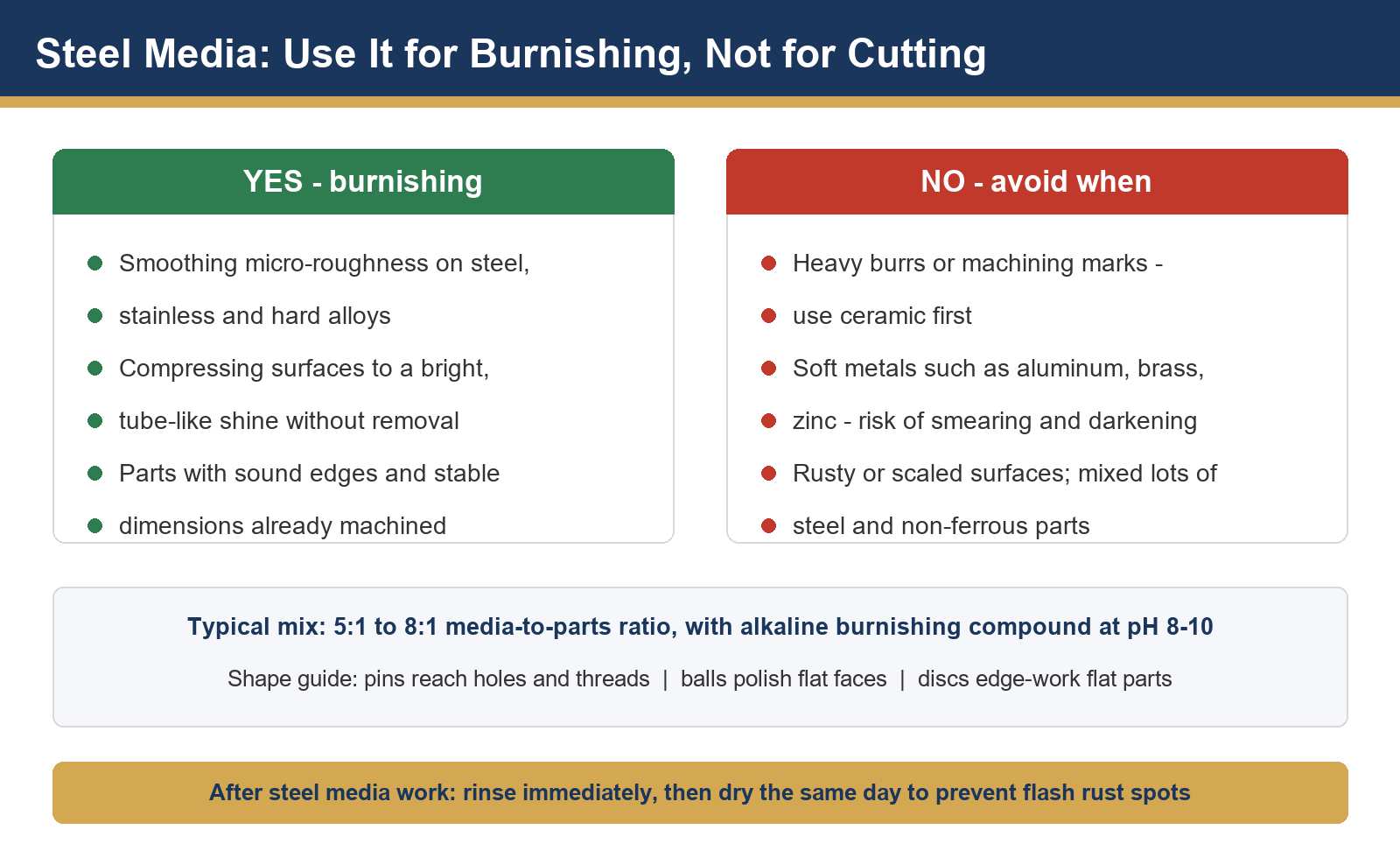
Core idea. Steel media does not remove metal; it re-distributes it. That is why its shine is brilliant but its correction ability is nearly zero — every burr, mark, or machining line you want gone must be removed by an earlier cutting stage.
1. What Steel Media Actually Does
Burnishing is a surface-compression process. Under the combined pressure of hundreds of hardened steel contacts per minute and an alkaline burnishing compound, surface asperities flow sideways and flatten. The result is a reflective, work-hardened surface with no material loss and virtually no dimensional change — which is exactly why steel media is preferred for precision parts where tolerances cannot move.
2. Shapes and Sizes of Steel Media
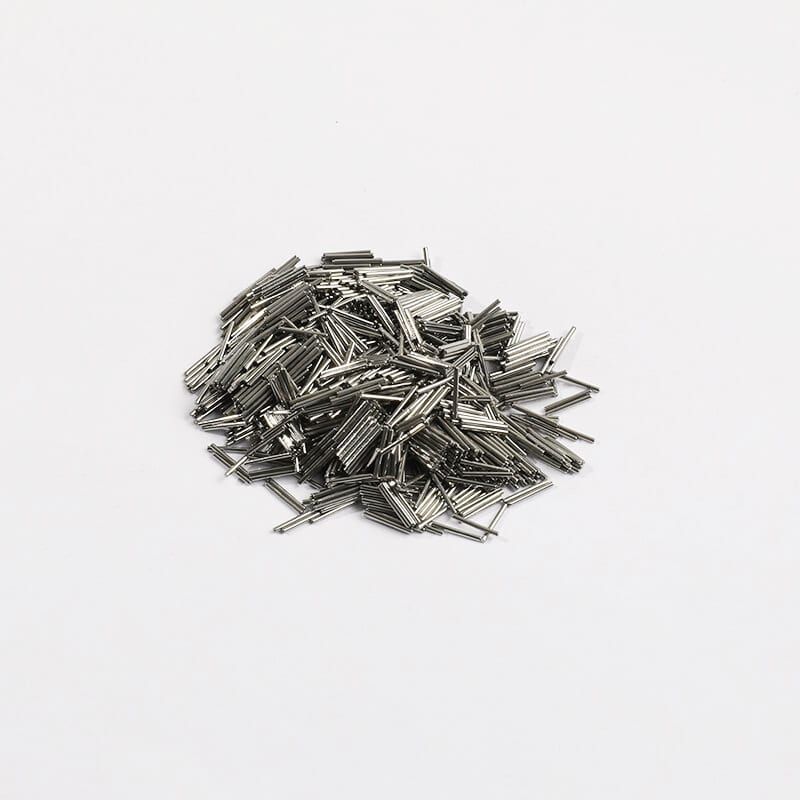
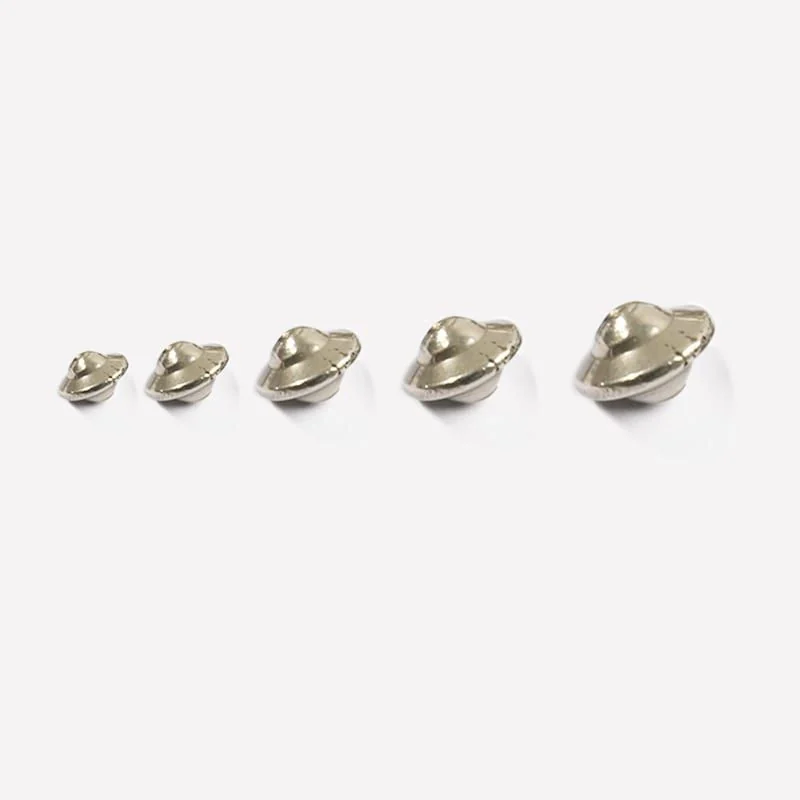
| Shape | Best For | Watch Out |
| Pins (needles) | Threads, holes, intricate channels — typical in magnetic finishers | Can jam into very fine features below 0.5 mm |
| Balls / dish balls | Flat faces, ring bands, coin and logo surfaces | Rolls away from edges; poor on recesses |
| Discs / wedges | Flat stampings, blade faces, edge work | Sharp disc rims can leave micro-lines on soft alloys |
3. Compound Pairing and Process Settings
- Alkaline burnishing compound: keeps steel bright, suspends soils, and provides lubricity. A mildly alkaline solution is the standard starting point.
- Media-to-parts ratio: begin around 5:1 to 8:1 by volume for bulk parts; higher ratios protect delicate parts from part-on-part contact.
- Cycle length: burnishing works fast once surfaces are pre-smoothed; run short cycles and inspect rather than committing to long runs.
- Rust discipline: never let wet steel media sit idle overnight without compound circulation — free water causes flash rust that transfers to the next batch.
4. Where Steel Media Shines (Literally)
- Watch cases and bracelets after ceramic pre-finishing.
- Jewelry findings, chains, and castings before plating.
- Machined stainless hardware needing a uniform satin-to-bright finish.
- Knife blades and tool faces where dimensional stability matters.
5. When NOT to Use Steel Media
Three failure modes. (1) Soft metals — aluminum, brass, zinc smear and darken under steel pressure instead of brightening. (2) Rough surfaces — burrs and deep marks survive burnishing unchanged; cut them with ceramic first. (3) Mixed lots — steel media plus loose non-ferrous parts in one load leads to contamination, embedded particles, and dull patches.
6. Maintenance and Care of Steel Media
Steel media lasts for years when kept clean. Rinse after each batch, store submerged in compound solution or fully dried, and re-clean periodically with a media cleaner compound when shine output drops. Rusty or blackened media must be cleaned before reuse — running parts with dirty steel transfers stains instantly.
7. Quick Selection Checklist
- Surface already smooth? If not — add a ceramic stage first.
- Part material harder than brass? Good candidate. Softer — reconsider.
- Need reach into threads and channels? Pins, ideally in a magnetic finisher.
- Need maximum flat-face gloss? Dish balls in a vibratory bowl.
Browse our steel finishing media range, see how pins work inside our magnetic finishing machines, or revisit our guide on preventing part-on-part damage when loading valuable batches.
Wondering if burnishing suits your parts?
Send samples with your current finish. We will test steel-media burnishing against ceramic alternatives and share real results.
Contact Our Finishing TeamOfficial website: www.surface-polish.com | Support email: info@surface-polish.com
Frequently asked questions
How does steel media create a mirror shine?
Steel media works the surface through repeated low-amplitude contact rather than cutting, which flattens surface peaks and produces reflectivity. The effect depends on the starting surface: a surface with deep scratches will show brightness but not a clean mirror.
When should steel media not be used?
Steel media is a poor choice for soft materials that mark easily, for parts where any iron contamination is unacceptable, and for parts that are already at their final dimension. It also should not be used to remove material, because that is not what it does.
What shapes does steel media come in?
Common shapes include balls, ovals, diagonals and pins, each with a different reach and contact pattern. Shape is chosen from the features that must be reached — slots, holes and internal surfaces decide it.
Does burnishing change part dimensions?
Burnishing changes the surface rather than the overall dimension, but the surface itself is worked and can shift slightly. On parts held to a tight surface requirement, the effect should be confirmed by measurement on a sample.
What is needed for a repeatable burnishing result?
A stable media charge, a compound suited to burnishing, a controlled cycle time and a consistent load. Recording these from the trial is what makes the result repeatable rather than remembered.
Answers are directions to test on a sample part, not validated results for a specific component.
 +86-592-2381506


 IPv6 network supported
