


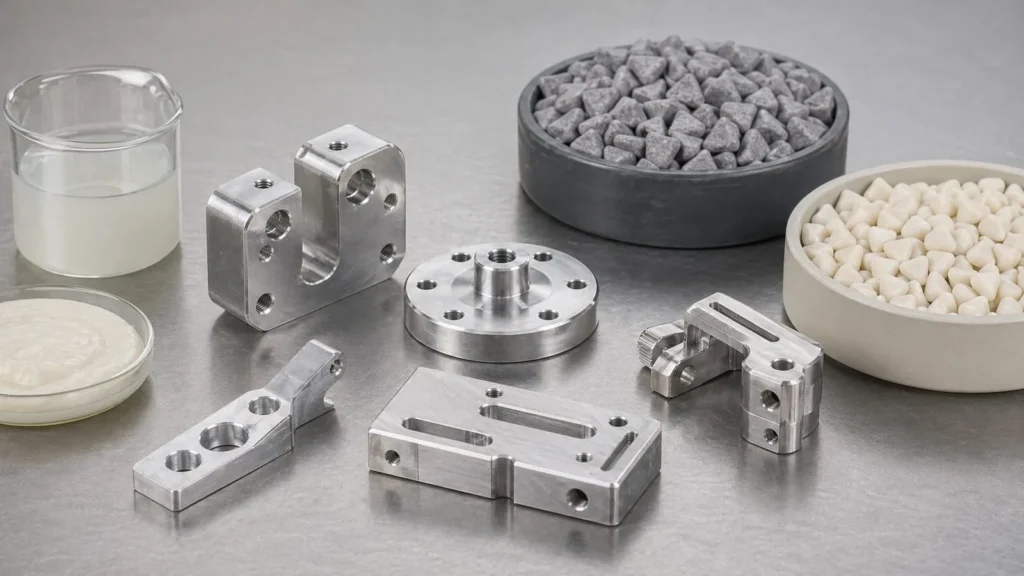
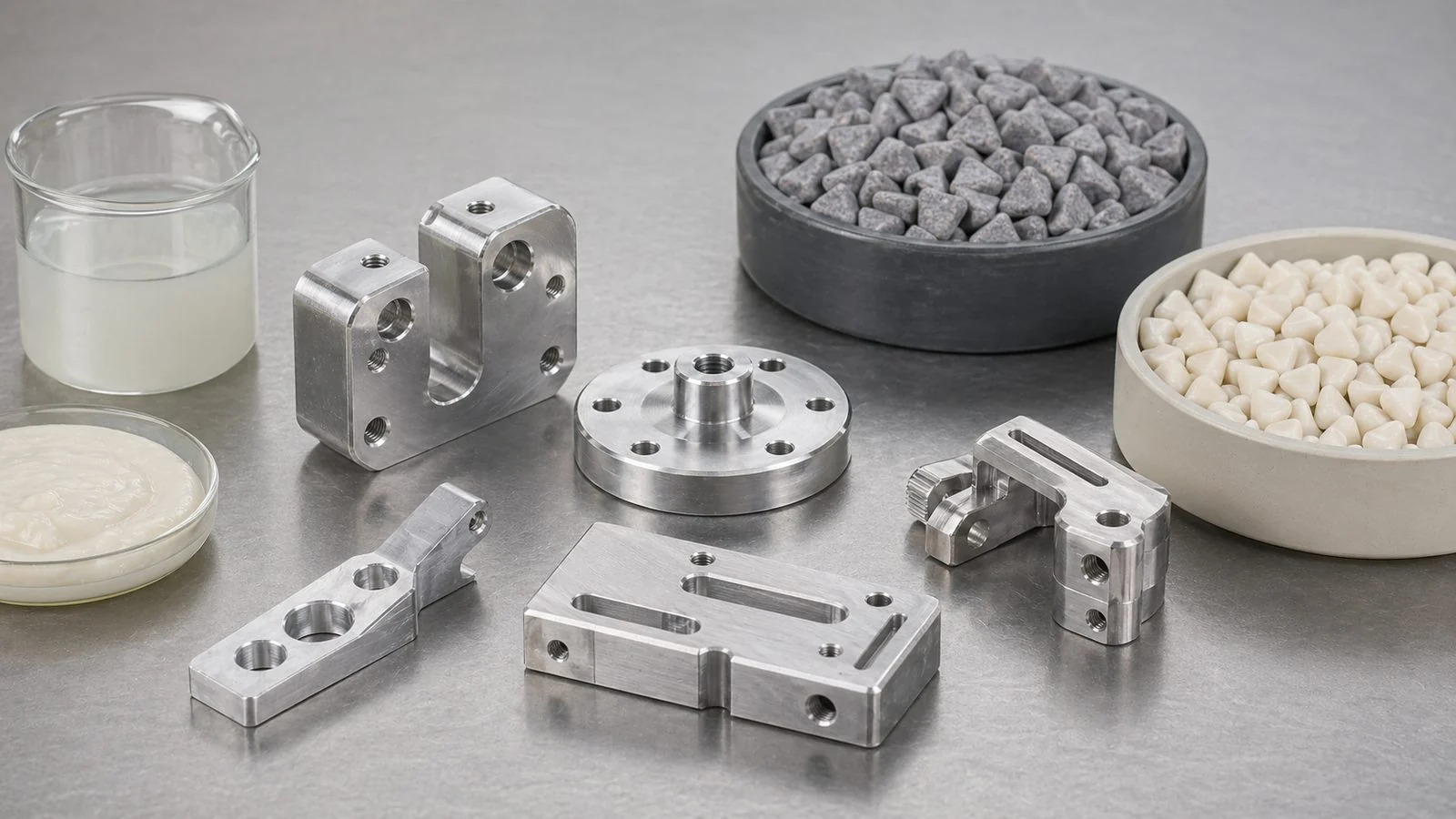
CNC aluminum components often combine cosmetic faces with sealing lands, threads, slots, pockets, and tightly toleranced edges. That makes deburring different from simply making a part look smooth. A successful process must reach the burr while protecting every feature that still has to assemble, seal, locate, or pass inspection.
The best result normally comes from treating the machine, media, compound, water, loading ratio, cycle time, separation, and drying method as one validated recipe. Changing only the abrasive grade rarely solves a process that is damaging edges.
First Define the Burr and the Edge That Must Be Protected
"Remove the burr without edge damage" is not a measurable process target. Before testing, identify the burr source, its location and orientation, and how much edge change is acceptable. A thin drilling burr at a through-hole behaves differently from a folded milling burr along a slot or a heavy breakout burr at an interrupted cut.
Record height, thickness, direction, consistency, and whether it is loose, sharp, folded, or attached to a heavy root.
Mark sealing faces, sharp functional corners, threads, small holes, thin walls, engraved details, and datum surfaces.
Define the permitted edge radius, remaining burr limit, roughness or appearance target, and downstream coating requirement.
Record part weight, batch quantity, required pieces per hour, changeover frequency, and acceptable reject rate.
Is Mass Finishing the Right Deburring Method?
Mass finishing is well suited to repeatable batch deburring when media can contact the target edges and the parts can move safely. It is especially useful for light burr removal, controlled edge radiusing, removal of fine tool marks, cleaning, and surface preparation before anodizing or coating.
It is less suitable when only one local edge may be touched, the part contains an extremely fragile feature, media cannot reach the burr, or every component must be isolated from contact. Those cases may require brushing, robotic deburring, thermal or electrochemical methods, abrasive flow processing, or fixture-based finishing. The selection should follow the drawing and acceptance criteria, not only the part material.
Choose the Machine According to Part Geometry and Damage Risk
A vibratory finishing machine is a practical starting point for many CNC aluminum batches because the process is observable and can combine finishing, separation, rinsing, and drying. A centrifugal disc finishing machine can deliver a faster, higher-energy action, but its process window may be narrower for delicate parts.
| Machine Direction | Where It Fits | Main Risk to Validate |
|---|---|---|
| Vibratory bowl | General-purpose batch processing, mixed geometries, and processes that benefit from integrated separation | Part-on-part contact, poor circulation, or media lodging in holes and slots |
| Vibratory tub | Long or larger components and applications that may use dividers or compartments | Dead zones, part orientation, transfer damage, and separation method |
| Centrifugal disc | Small to medium parts requiring shorter cycles and stronger cutting action | Rapid edge-radius growth, nesting, contact damage, and heat or foam buildup |
For a broader comparison of bowl and tub designs, usable capacity, and line configuration, see our vibratory finishing machine selection guide.
Why Plastic Media Is Often the Starting Point for Aluminum
Plastic-bonded abrasive media has lower density and generally produces a gentler impact than dense ceramic media. That makes plastic finishing media a common starting direction for aluminum, zinc, brass, copper, thin parts, and cosmetic surfaces. It can remove light burrs and machining lines while reducing the risk of deep impingement marks.
This does not mean plastic media is automatically safe or that ceramic media can never be used on aluminum. A hard alloy, robust geometry, or heavier stock-removal target may justify a controlled ceramic-media trial. The result depends on media formulation, size, shape, machine energy, part loading, and cycle time.
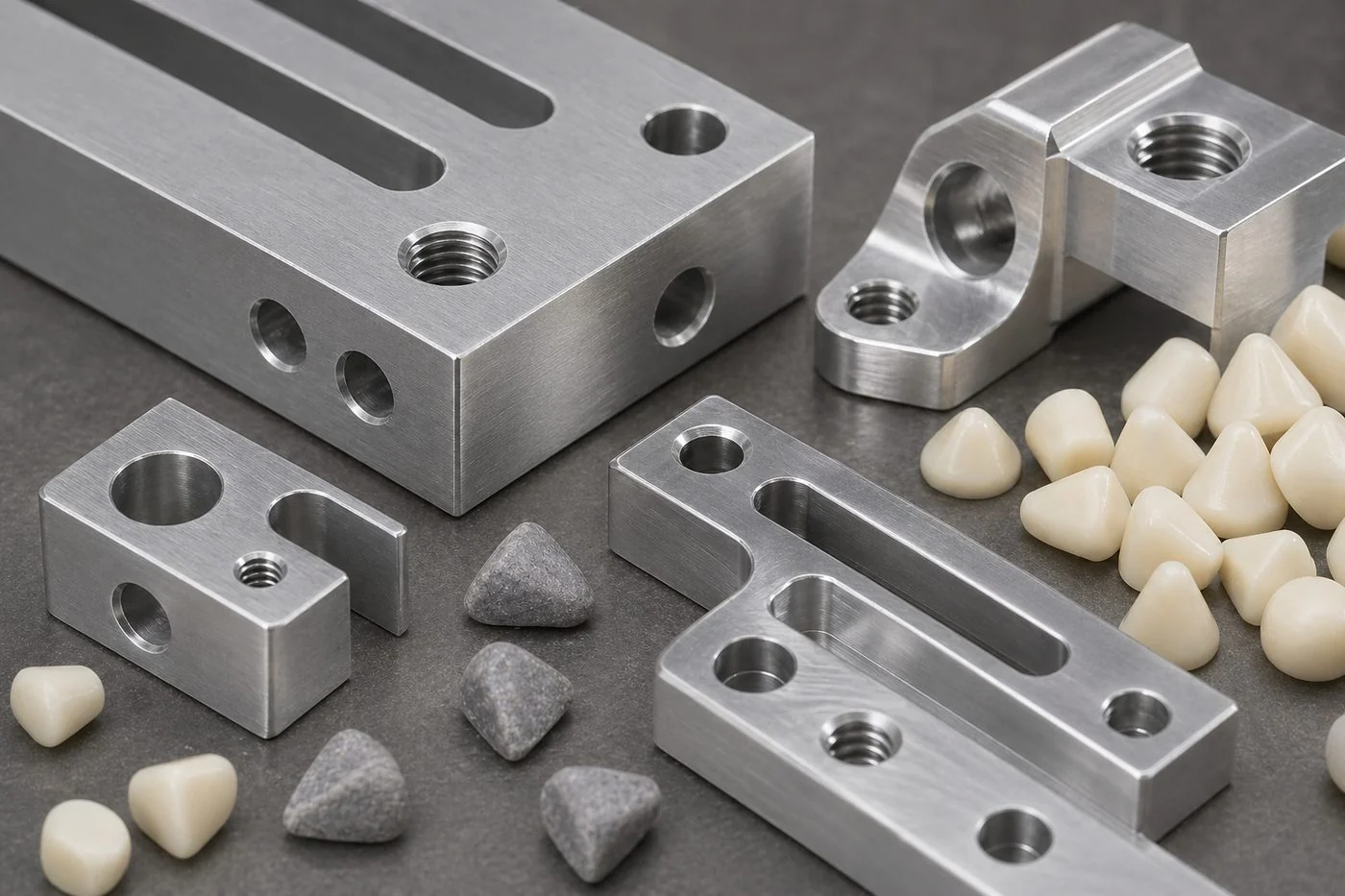
Media shape and size matter as much as abrasive grade
- Match access to the burr. The media must contact the edge without becoming trapped behind a shoulder or inside a pocket.
- Avoid dimensional matches. Compare every media dimension with holes, slots, counterbores, threads, and gaps across the media's worn size range.
- Check separation early. A recipe is not production-ready if finished parts cannot be separated reliably from the media.
- Account for wear. Media becomes smaller during use. A size that is safe when new may later lodge in an opening or pass through a separation screen.
Prevent Part-on-Part Contact and Cosmetic Damage
Aluminum surfaces can pick up dents and witness marks when parts collide. The media must do more than cut the burr: it also separates and cushions the workpieces. The correct media-to-parts ratio cannot be selected from chamber volume alone because part weight, geometry, nesting behavior, and cosmetic sensitivity all change the contact risk.
- Begin with a small number of marked parts and enough media to keep them separated during the complete circulation path.
- Observe loading, steady-state movement, separation, discharge, and transfer to the dryer.
- Inspect broad faces and corners under side lighting for new contact marks.
- Increase the part load step by step only after the previous level passes inspection.
- Define production capacity as accepted parts per cycle, not the maximum amount that physically fits in the chamber.
Use Compound and Water to Control Cleaning, Staining, and Cutting
The liquid system carries removed metal and abrasive fines away, keeps media clean, helps control foam, and influences the final surface. Select an aluminum-compatible finishing compound and follow its recommended starting concentration. More compound is not automatically better; overdosing can increase foam or leave residue, while insufficient cleaning can allow fines to redeposit.
- Use a repeatable dosing method and record water flow, concentration, temperature, and solution condition.
- Check whether the selected chemistry is compatible with the specific aluminum alloy and the next operation.
- Keep the bowl, drains, tank, screens, and media free of chips from previous jobs.
- Rinse completely and begin drying promptly to reduce water spots and oxidation marks.
- Inspect blind holes and pockets where dirty liquid may remain after separation.
Build the Recipe with Short, Measured Trials
The safest way to protect a critical edge is to measure progress over time. Use parts from the same machining condition, preserve an untreated control, and change only one variable in each test. Short timed samples reveal whether the burr is being removed before excessive radiusing begins.
Photograph and measure burrs, functional edges, critical dimensions, and surface condition.
Confirm circulation, media coverage, part separation, and absence of nesting or lodging.
Remove marked parts at fixed intervals, then rinse and dry them completely.
Compare remaining burr, edge radius, roughness, appearance, and critical dimensions.
Change media, time, compound, flow, machine energy, or loading - not several at once.
Repeat the approved recipe with the intended batch size and complete post-process route.
Troubleshooting CNC Aluminum Deburring Defects
| Observed Result | Likely Cause | Controlled Test |
|---|---|---|
| Burr remains but edge radius grows | Media cannot reach the burr root, burr is too heavy, or machining created a folded burr | Review upstream machining and test a shape that reaches the burr without matching nearby openings |
| Dents or random contact marks | Part-on-part collision, insufficient cushioning, overload, or damage at transfer points | Reduce the part count and increase media coverage while keeping other settings unchanged |
| Deep scratches | Metal-chip contamination, broken or mixed media, or an overly aggressive recipe | Clean the full system and run a known reference part with clean media |
| Gray film, smut, or staining | Incompatible chemistry, overloaded solution, poor rinsing, unsuitable water, or delayed drying | Prepare fresh solution at the recommended concentration, add a clean rinse, and dry immediately |
| Media stuck in holes or slots | Media dimension matches a feature now or after wear | Test a non-lodging shape or size and verify the complete separation route |
| Inconsistent parts within one batch | Unstable circulation, mixed starting surfaces, nesting, or uneven liquid distribution | Run a smaller sorted batch and observe movement in every area of the chamber |
Prepare the Surface for Anodizing, Coating, or Assembly
A deburred part is not automatically ready for the next process. Mass finishing changes the surface texture and may leave abrasive fines, compound residue, or retained liquid. If the part will be anodized, plated, painted, bonded, sealed, or assembled, confirm cleanliness and surface condition with the downstream supplier or internal process owner.
Keep accepted samples from both before and after the downstream process. A surface that looks uniform before anodizing may reveal alloy or machining differences after color development, so the complete route - not only the deburring step - must be validated.
Information Needed for a Reliable Process Trial
- Aluminum alloy and temper, part drawing, dimensions, weight, and annual or daily quantity
- Photos of the incoming burr and the exact edges that must remain protected
- Maximum acceptable edge radius, dimensional tolerances, and cosmetic standard
- Hole, slot, pocket, thread, and internal-feature dimensions relevant to media lodging
- Required final roughness or visual finish and the next operation, such as anodizing or coating
- Current equipment, media, compound, cycle time, defects, and target production rate
Need a deburring process for CNC aluminum parts? Send part photos, the alloy, dimensions, burr location, protected edges, target finish, and batch quantity. We can recommend a machine, media, compound, and controlled trial direction.
Frequently Asked Questions
What media is best for deburring CNC aluminum parts?
Plastic abrasive media is often the first trial direction because its lower density provides a gentler action on aluminum and cosmetic surfaces. The correct grade, shape, and size still depend on the burr, protected features, target finish, machine, and lodging risk.
Can ceramic media be used on aluminum?
Yes, in some applications. Ceramic media may provide faster cutting, but its higher density can increase surface marking and edge-radius growth. Use a controlled trial and measure critical features rather than selecting media by material name alone.
How do I prevent sharp edges from becoming too rounded?
Start with short timed samples, gentler media, safe machine motion, and a measurable edge-radius limit. If the burr remains while the surrounding edge keeps rounding, improve burr access or reduce the burr during machining instead of simply extending the finishing cycle.
Why do aluminum parts turn gray or develop stains after tumbling?
Possible causes include incompatible chemistry, dirty solution, metal-fine redeposition, unsuitable water, incomplete rinsing, retained liquid, or delayed drying. Test fresh aluminum-compatible solution, a clean rinse, and immediate drying while holding mechanical settings constant.
Will vibratory finishing remove machining lines?
It can reduce light tool marks and create a more uniform texture, but the required stock removal may also change dimensions and edge radii. Deep cutter marks should be addressed in machining or evaluated with a staged finishing process.
How long should CNC aluminum parts be tumbled?
There is no universal cycle time. It depends on alloy, burr size, part geometry, media, compound, machine energy, load, and acceptance target. Establish the shortest repeatable cycle through timed samples and dimensional inspection.
Related Equipment and Process Resources
Protect the Edge by Controlling the Complete Recipe
Reliable aluminum deburring comes from matching burr access, media, machine motion, cushioning, chemistry, time, and inspection. Validate the process on marked samples, measure critical edges, and confirm the final recipe at production load.
Related business: jingseyewear
Frequently asked questions
Why is edge damage a problem on CNC aluminium parts?
Aluminium is soft, so an abrasive that removes the burr can round the edge at the same time. On parts where the edge is functional — a sealing face, a mating edge or a thread start — that rounding changes the part, not just its appearance.
What causes burrs to remain after deburring?
The usual cause is that the media cannot reach the feature. If the burr sits in a cross-hole, a slot or a recess smaller than the media, no amount of extra cycle time will remove it. Media shape and size have to suit the actual geometry.
What media suits aluminium deburring?
Media is chosen from the feature to be reached and then from the surface the part is allowed to lose. Softer media such as plastic is often used on aluminium because it cuts more gently than ceramic, at the cost of a slower cycle.
Can CNC parts be deburred without changing dimensions?
Mass finishing always removes some material, so the question is how much and where. A short cycle with the right media can remove the burr while staying within the edge requirement, and that has to be confirmed by inspection on a sample.
How should the result be checked?
Check the critical features rather than the flat surfaces: edges, thread starts, cross-hole intersections and any face that has to seal or mate. Those show a problem before the general surface does.
Answers are directions to test on a sample part, not validated results for a specific component.
 +86-592-2381506

 IPv6 network supported