


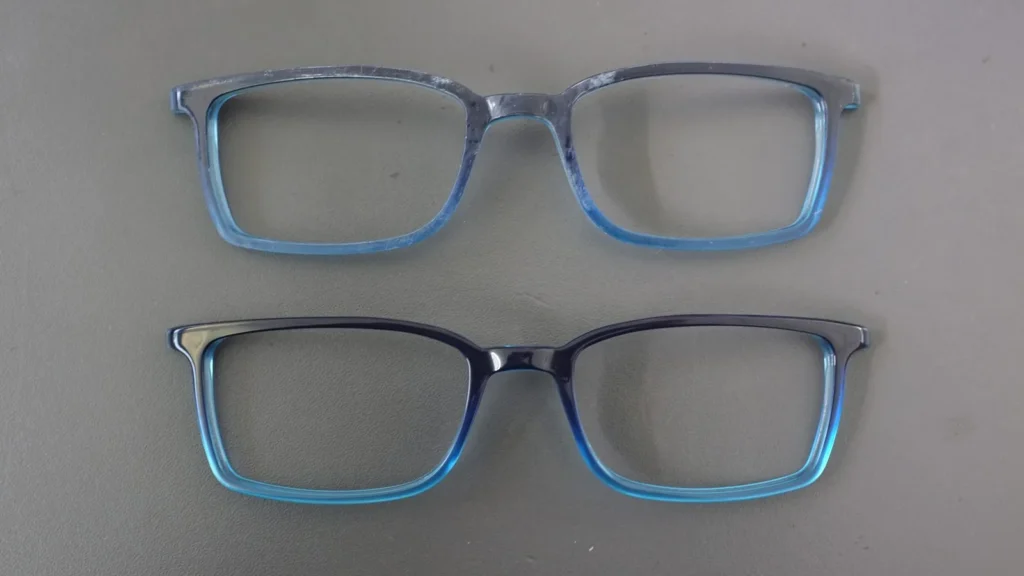
How to Polish Plastic Eyeglass Frames Without Whitening, Scratches, or Deformation
Plastic and acetate eyeglass frames are difficult to polish in batches because the surface must become bright and smooth without whitening, deep scratches, rounded corners, or heat deformation. A process that is too aggressive can damage the frame shape. A process that is too weak leaves mold marks, sanding marks, dull edges, or cloudy areas around the bridge and temples.
This guide explains how to diagnose common polishing problems on plastic eyeglass frames and how to build a more stable finishing process for frame fronts, temples, corners, and visible outer surfaces.

Why Plastic Eyeglass Frames Are Easy to Damage
Plastic frame materials such as acetate, PC, TR-type plastics, and other decorative plastics can look premium when polished correctly, but they are sensitive to heat, impact, and over-cutting. The surface may become cloudy or white if the polishing action is too dry, too hot, too rough, or too long.
Eyeglass frames also have many difficult areas: the bridge, lens groove, hinge zone, temple connection, inner corners, and thin edge transitions. These areas can trap media, receive uneven contact, or become rounded before the large visible surface becomes bright.
Start by Identifying the Defect
Do not solve every plastic polishing problem by increasing time. First decide whether the defect is a cutting issue, a heat issue, a media issue, or a loading issue.
| Defect | Likely Cause | What to Check | Recommended Adjustment |
|---|---|---|---|
| White or cloudy surface | Excessive friction, dry contact, or unsuitable media | Media type, moisture, compound, cycle time | Use gentler media and reduce heat or friction buildup |
| Fine scratches remain | Previous sanding marks too deep or media too coarse | Initial surface preparation and media grade | Add controlled smoothing before final polishing |
| Frame corners become rounded | Cycle time too long or contact too aggressive | Corner radius, edge definition, processing time | Shorten cutting stage and separate final polishing |
| Frame shape changes or warps | Heat, pressure, or excessive batch impact | Machine motion, load size, drying temperature | Reduce heat exposure and avoid heavy part-on-part contact |
| Bridge or hinge areas remain dull | Media cannot reach narrow or recessed areas | Media size, lens groove, hinge geometry | Test smaller or better-shaped media without causing lodging |
Use a Gentler Process Than Metal Deburring
Plastic eyeglass frames should not be treated like stainless steel or die-cast parts. Heavy cutting media may remove material quickly, but it can also create haze, edge loss, or deformation. For plastic surfaces, the process should focus on controlled smoothing and gradual brightness improvement.
Depending on the material and surface condition, plastic media, selected soft finishing media, or dry finishing media may be more suitable than aggressive cutting media. The final choice depends on frame material, sanding mark depth, corner requirements, and target gloss.
Control Heat and Friction
Heat is one of the biggest risks in plastic frame polishing. Even if the frame does not visibly melt, excess friction can soften the surface, create cloudy areas, or make sharp details look rounded. Dry polishing, long cycle time, and dense loading can all increase temperature.
If whitening appears after the process, check whether the parts were overheated or rubbed too aggressively. A shorter process with better media selection is often safer than a long cycle with strong friction.
Prevent Part-on-Part Damage
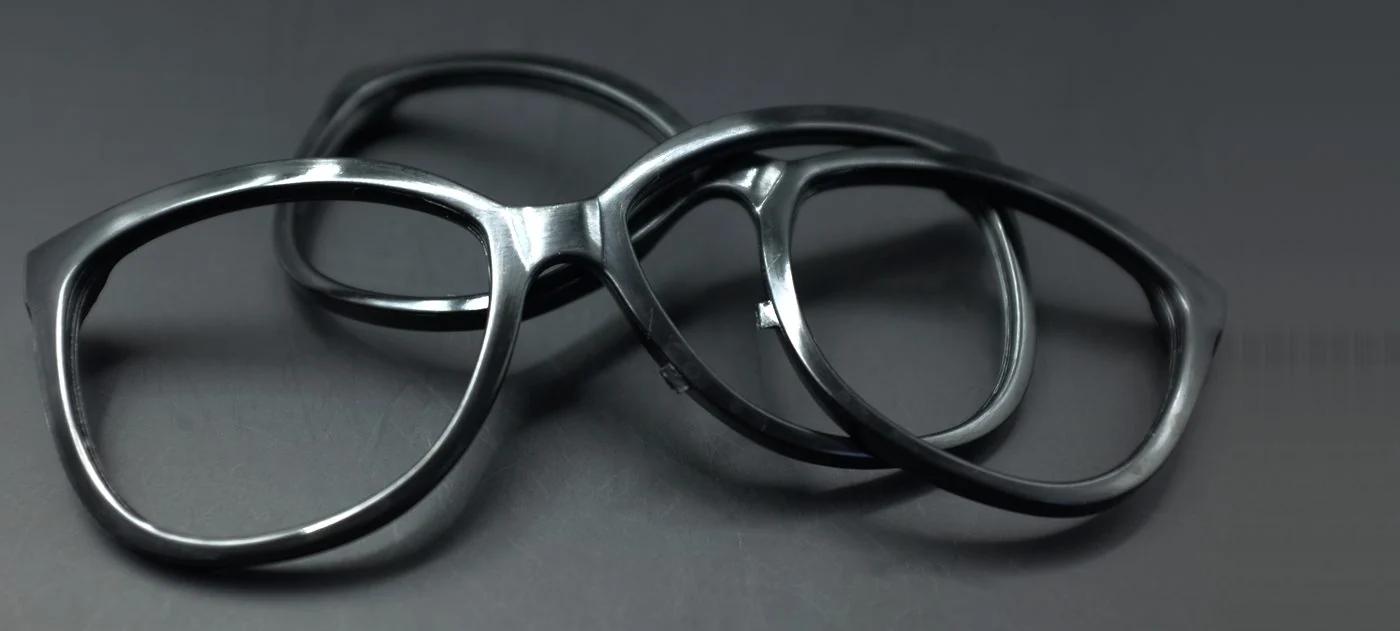
Eyeglass frames are light, thin, and easy to scratch. If too many frames are loaded together, they can rub or hit each other during finishing. This creates new marks that must be repaired manually.
Loading ratio matters as much as media selection. The parts should be supported by enough media so frames do not stack, twist, or rub directly against each other. For some frame designs, a gentler machine motion or special fixture method may be needed.
Choose the Machine by Frame Shape
A standard vibratory finishing machine can work for many small plastic components, but eyeglass frames may require lower impact and better control. For delicate frames, a slower tumbling or dedicated plastic polishing process may reduce scratches and deformation.
If the frames are long, thin, or easily tangled, the key question is not only machine capacity. You need to test whether the frames move freely, stay separated, and receive even contact around the bridge, temples, and lens grooves.
Use Compound or Dry Media Carefully
In wet processing, finishing compounds can help lubrication, cleaning, and surface protection. In dry finishing, the media must be clean and suitable for the plastic surface. Dirty or worn media can transfer residue and create uneven gloss.
If the frame looks bright in some areas but hazy in others, check media cleanliness, compound residue, drying method, and whether narrow areas are trapping dust or slurry.
When to Use a Two-Stage Process
Many plastic eyeglass frames need at least two stages. One step removes sanding marks or mold marks. Another step improves gloss and surface uniformity. Trying to do both in one strong process often causes whitening or edge loss.
- Stage 1: controlled smoothing to remove visible sanding marks and surface unevenness.
- Stage 2: gentle polishing to improve gloss without overheating the frame.
- Final check: inspect bridge areas, corners, lens grooves, and temple connection points.
Common Mistakes to Avoid
- Using metal deburring logic on plastic frames.
- Increasing cycle time until the surface turns white or edges lose definition.
- Ignoring heat buildup during dry or high-friction finishing.
- Loading too many frames together and creating scratches from part-on-part contact.
- Choosing media that cannot reach lens grooves or bridge corners.
- Skipping final inspection under consistent lighting.
Frequently asked questions
Can scratches be polished out of eyeglasses?
Yes, up to a limit. Scratches are removed by taking the surface down to the depth of the mark, so a deep gouge may not come out without changing the frame geometry. Surface scuffs and handling marks are normally removable. Check the depth before choosing a process, because polishing over a deep scratch only moves material around it.
Why do black plastic glasses frames turn white?
Whitening is usually heat and mechanical stress rather than the abrasive itself. When a frame is pressed hard against a fast-moving surface, the plastic stretches and micro-cracks, and those cracks scatter light. Lowering pressure and shortening the contact time normally matters more than changing the abrasive.
How do I make glasses frames shiny again?
Shine comes from the last stage of the sequence, not from one long pass. A frame that has lost its gloss normally needs a controlled smoothing stage first, then a finishing stage with a finer media or compound. Trying to brighten a dull frame in a single step usually produces an uneven, patchy gloss.
Can acetate frames be polished the same way as plastic ones?
Acetate responds more strongly to heat and to solvent contact than many other plastics, so it is less forgiving. The same sequence works in principle, but with a gentler first stage and closer heat control. A process that is safe for one plastic can haze or deform acetate.
How is a plastic frame different from metal when polishing?
Plastic marks and deforms under load instead of cutting cleanly, and it softens at temperatures metal never reaches in a finishing process. That means lower pressure, shorter cycles and lighter media than the equivalent metal part.
What causes part-on-part damage during frame polishing?
Frames are thin and asymmetric, so they deform when the batch load is too high or when parts press against each other. Reducing the load and using media that supports the frame, rather than striking it, keeps the geometry intact.
Related SolutionsIf you are improving plastic eyeglass frame polishing, these pages may help you compare suitable finishing media, compounds, and machine options:
Need a Safer Polishing Process for Plastic Frames?
Send us your frame material, photos, current surface condition, sanding mark depth, whitening problem, target gloss, and batch quantity. Jintaijin can help review whether your process needs different media, shorter cycle time, better loading control, or a two-stage polishing route.
Contact our finishing team for plastic eyeglass frame polishing support
 +86-592-2381506


 IPv6 network supported
