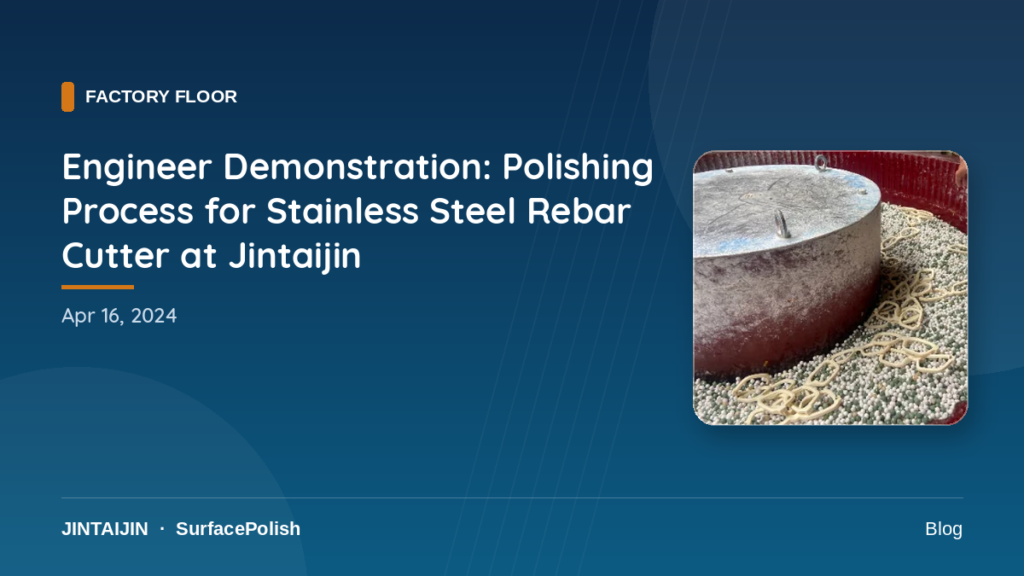
At Jintaijin, we are committed to providing the highest quality polishing solutions. Today, our engineer will demonstrate how to use a centrifuge to polish a stainless steel rebar cutter, giving the product a fresh new look.
Finish Polishing: Once the polishing is complete, stop the centrifuge and remove the stainless steel rebar cutter for final cleaning and inspection.
| Part feature | Consideration | Starting direction |
|---|---|---|
| Cutting edge at the jaw | Edge is the function of the tool | Protect the edge or finish it separately |
| Large flat machined faces | Flat surfaces are easier to finish evenly | Use media that rolls across the face |
| Internal pivot and recesses | Media must reach or the feature stays untouched | Size the media below the recess |
| Hand-tool cosmetic surface | Appearance matters for the sale | Staged sequence ending with a finer grade |
| Corrosion protection after finishing | Stainless still marks in handling and storage | Consider how the part is handled after drying |
Directions to test on a representative sample, not validated results for a specific component.
A rebar cutter is a tool whose function is at its edge, and that single fact constrains the whole finishing process. Mass finishing improves a surface by removing material, and the material it removes first is at the edges, because that is where the media makes contact most often. On a tool, that is exactly the material that has to stay.
The practical consequence is that the working edge is normally either protected during processing or finished in a separate operation. Scoping the mass-finishing stage to the surfaces that are not the working edge is not a compromise — it is the correct division of labour. The surfaces that can be worked benefit from the process; the edge is handled on its own terms.
A rebar cutter typically has several distinct surfaces with different requirements. The large flat machined faces are the easiest: they can be reached by media that rolls across them, and a uniform surface is achievable. Internal recesses and the pivot area are harder, because whether the media reaches them depends entirely on the media size relative to the opening. Media that cannot enter the recess leaves it untouched, and no additional cycle time changes that.
The cosmetic surface deserves its own stage. Where the tool is sold on appearance as well as function, the finish that matters is the one produced by the final stage, so a sequence that steps down through grades is what produces an appearance that holds up. Trying to reach the final surface from the initial state in one operation generally means either a surface that is not bright enough or an edge that has gone too far.
Email : info@surface-polish.com


 IPv6 network supported


 +86-592-2381506
